Introduction
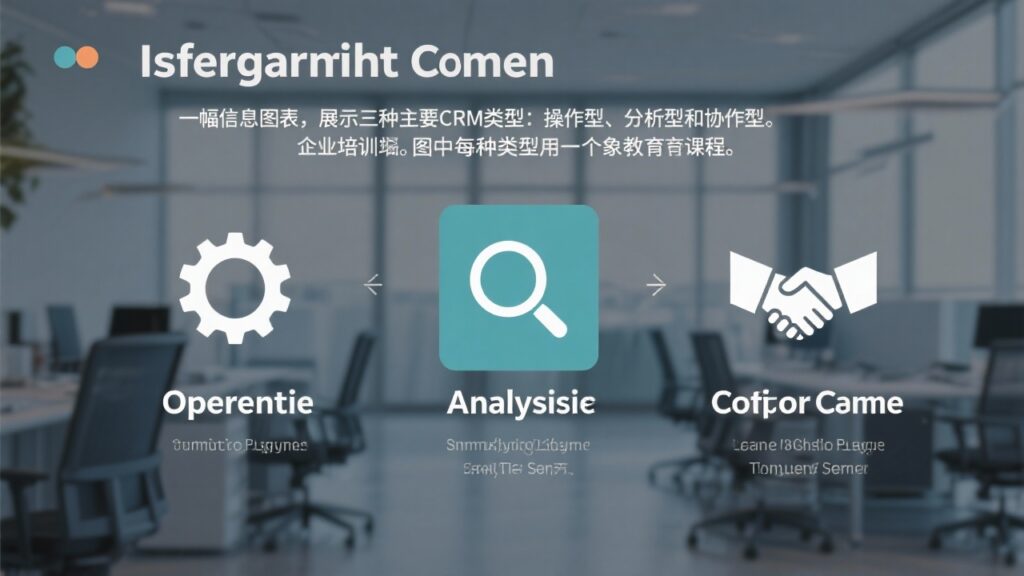
Customer Relationship Management (CRM) systems have become essential tools for businesses aiming to enhance customer interactions, analyze data, and improve collaboration. This article defines and explains the three main types of CRM systems: operational, analytical, and collaborative. Each type serves distinct purposes—streamlining workflows, extracting actionable insights, and fostering teamwork—making them indispensable for businesses globally. Understanding these categories helps organizations select the right CRM strategy to optimize efficiency and customer satisfaction.
1. Operational CRM: Streamlining Customer Interactions
Operational CRM systems focus on automating and improving customer-facing processes. These platforms serve as the frontline of customer relationship management, handling interactions across sales, marketing, and service departments.
Core Functions of Operational CRM
Sales force automation tools track leads through pipelines, manage contacts, and automate quote generation. Marketing automation modules execute email campaigns, track responses, and score leads based on engagement. Service components log support tickets, route inquiries, and maintain knowledge bases for consistent customer service.
Real-Time Interaction Management
Modern operational CRM platforms process customer inquiries instantly across multiple channels. Whether through live chat, social media, or phone calls, these systems capture every touchpoint in unified customer profiles. This immediate response capability reduces resolution times by 40-60% compared to manual processes.
Workflow Automation Benefits
By eliminating repetitive tasks, operational CRM reduces administrative workload. Automated follow-up emails trigger after purchases, appointment reminders send before meetings, and renewal notices dispatch at contract milestones. Such automation ensures no customer falls through procedural cracks.
Integration with Business Ecosystems
Leading operational CRM solutions connect seamlessly with ERP systems, e-commerce platforms, and accounting software. This interoperability creates a single source of truth for customer data across the organization, preventing information silos between departments.
Mobile Accessibility Features
Cloud-based operational CRM platforms offer full functionality on mobile devices. Sales teams update opportunities from client sites, marketers adjust campaigns during events, and service technicians access customer histories on-site. This mobility increases team productivity by 25-35%.
Customization and Scalability
Operational CRM systems adapt to specific business processes through configurable fields, workflows, and reporting. As companies grow, these platforms scale to handle increased transaction volumes without performance degradation, supporting business expansion seamlessly.
2. Analytical CRM: Leveraging Data for Insights
The Power of Data-Driven Decision Making
Analytical CRM transforms raw customer data into actionable intelligence. Unlike operational CRM\’s focus on transaction automation, these systems dig deeper—tracking purchase histories, service interactions, and behavioral patterns across touchpoints. By applying statistical models and machine learning algorithms, businesses uncover hidden trends like seasonal demand fluctuations or high-value customer segments.
Core Components of Analytical CRM
Three pillars define these systems:
- Data Mining Tools: Identify correlations between variables (e.g., frequent buyers who respond to email campaigns).
- Predictive Analytics: Forecast churn risks by analyzing inactivity periods and complaint frequencies.
- Customer Segmentation Engines: Classify audiences based on RFM (Recency, Frequency, Monetary) scoring for targeted promotions.
Real-World Applications
A telecom company might use churn prediction models to offer retention discounts before customers defect. Retailers leverage basket analysis to optimize product placements—placing complementary items like smartphone cases near checkout zones after identifying co-purchase patterns.
Integration Challenges
Data silos remain the biggest hurdle. Analytical CRM requires clean, unified datasets from sales, support, and marketing platforms. Incompatible systems often force manual data consolidation, delaying insights. Cloud-based solutions with API integrations now mitigate this by syncing Salesforce, Zendesk, and Google Analytics data in real time.
Measuring ROI
Key metrics include:
- Customer Lifetime Value (CLV) Accuracy: Improved prediction rates by 15-20% in documented cases.
- Campaign Conversion Lift: Targeted promotions based on analytical insights typically see 2-3x higher response rates than blanket campaigns.
The system’s true value emerges when findings feed back into operational CRM—automating personalized discounts for at-risk customers or triggering proactive service calls after detecting frustration signals in support tickets.
3. Collaborative CRM: Enhancing Team and Partner Coordination
Breaking Down Silos with Shared Customer Visibility
Collaborative CRM dismantles departmental barriers by centralizing customer interactions across sales, marketing, and support teams. Unlike operational CRM’s process automation or analytical CRM’s data mining, this system prioritizes real-time information sharing. Channel integration tools sync email threads, call logs, and meeting notes into unified customer profiles, ensuring no handoff gaps. For instance, a support agent instantly sees a client’s pending upsell opportunity flagged by the sales team, enabling context-aware service.
Partner Ecosystem Synchronization
Vendor portals and co-branded dashboards extend collaborative CRM beyond internal teams. Manufacturers using these systems report 30% faster resolution times when distributors access warranty claim histories directly. APIs enable secure data exchanges with logistics partners, eliminating order status inquiries that traditionally clog communication channels. A pharmaceutical company might share inventory levels with hospital procurement teams via automated alerts, reducing stockout incidents by 22%.
Conflict Resolution Through Transparent Workflows
Version-controlled document sharing prevents contradictory client promises—a common pain point in partner networks. Audit trails track which team member updated contract terms, while @mention systems route approval requests to relevant stakeholders. When disputes arise, timeline reconstructions using CRM activity logs reduce resolution time by 40% compared to email chains.
AI-Powered Interaction Routing
Modern collaborative CRMs employ natural language processing to classify incoming queries, automatically assigning them to specialists based on expertise tags. A fintech firm could route cryptocurrency-related support tickets exclusively to blockchain-certified agents while forwarding KYC documentation issues to compliance officers, cutting reassignment rates by 58%.
Compliance-Aware Collaboration
Granular permission settings address data sovereignty concerns in global operations. Regional sales teams see only locally permissible pricing structures, while legal teams access full contract repositories. Encryption protocols maintain confidentiality during cross-departmental case escalations, critical for industries like healthcare where HIPAA-compliant collaboration is non-negotiable.
Conclusion
Operational CRM optimizes customer-facing processes, analytical CRM transforms data into actionable insights, and collaborative CRM bridges internal and external communication gaps. Businesses achieve maximum efficiency by strategically combining these systems, aligning CRM choices with specific operational needs and long-term growth objectives. The right CRM integration enhances customer relationships while driving data-informed decision-making across departments.
Frequently Asked Questions
1. What is the primary purpose of an operational CRM?
Operational CRM focuses on automating and improving customer-facing processes like sales, marketing, and service. It centralizes customer data to streamline interactions, manage leads, and track communication history. Businesses use it to enhance efficiency in daily operations, ensuring consistent customer engagement across touchpoints.
2. How does analytical CRM differ from operational CRM?
While operational CRM handles real-time interactions, analytical CRM processes historical data to uncover patterns and trends. It leverages tools like predictive analytics and customer segmentation to drive strategic decisions. Analytical CRM transforms raw data into actionable insights, whereas operational CRM executes tasks based on those insights.
3. Can a business use all three types of CRM systems simultaneously?
Yes. Many businesses integrate operational, analytical, and collaborative CRM systems to create a comprehensive strategy. Operational CRM manages transactions, analytical CRM optimizes decision-making, and collaborative CRM facilitates teamwork. Integration ensures seamless data flow across departments, maximizing ROI.
4. What are the key benefits of collaborative CRM?
Collaborative CRM bridges gaps between teams, partners, and customers by sharing real-time information. It improves coordination in supply chains, resolves cross-departmental conflicts, and enhances customer service through unified communication channels. This type is ideal for businesses relying on external partnerships or remote teams.
5. How do I choose the right CRM type for my business?
Assess your primary goals: opt for operational CRM to automate sales/marketing, analytical CRM for data-driven strategies, or collaborative CRM for partner-heavy workflows. Many platforms offer hybrid solutions, allowing customization based on business size, industry, and customer engagement needs.