Introduction
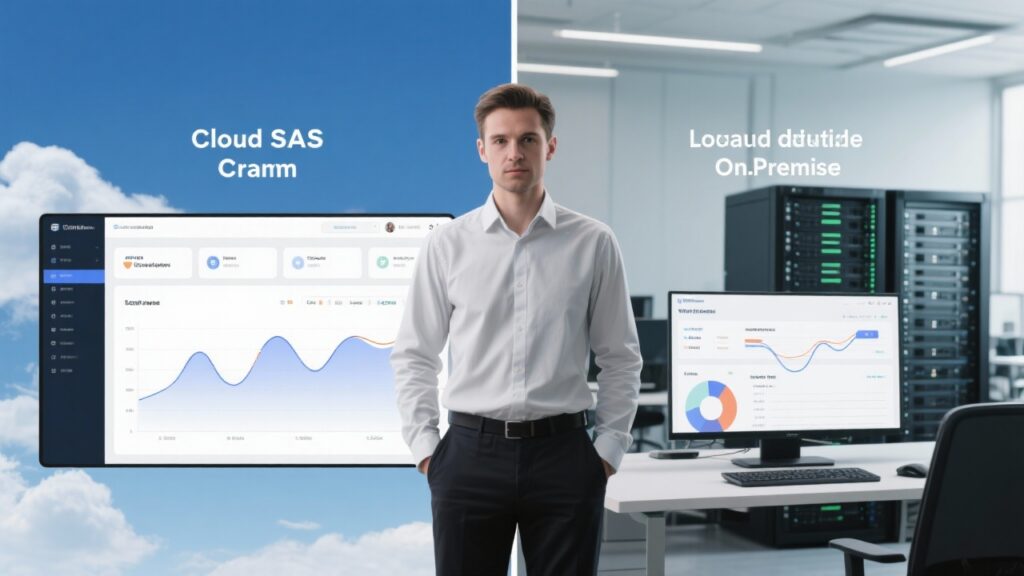
Choosing between SaaS CRM and On-Premise CRM is a critical decision that impacts your business operations, costs, and scalability. SaaS CRM offers cloud-based accessibility with lower upfront costs, while On-Premise CRM provides full control over data and customization but requires significant infrastructure investment. Understanding these key differences ensures you select the right model to align with your business needs. This guide breaks down each option to help you make an informed decision.
1. Understanding SaaS CRM and On-Premise CRM
Defining SaaS CRM
SaaS (Software-as-a-Service) CRM operates on a cloud-based model, where the vendor hosts the software and manages all technical infrastructure. You access the system via a web browser, eliminating the need for local installations. Updates are automatic, ensuring you always use the latest version without manual intervention. This model thrives on scalability—adding users or features often requires just a few clicks.
Defining On-Premise CRM
On-Premise CRM is installed directly on your company’s servers and managed by your internal IT team. You own the software licenses and control every aspect of data storage, security protocols, and customization. This model demands upfront hardware investments and ongoing maintenance but offers unparalleled control for industries with strict compliance needs, like finance or healthcare.
Core Philosophy Differences
SaaS prioritizes agility and cost-efficiency, ideal for businesses seeking rapid deployment and predictable operational expenses. On-Premise caters to organizations requiring deep customization and data sovereignty, trading higher initial costs for long-term autonomy. The choice hinges on your priorities: flexibility versus control, speed versus ownership.
Hybrid Approaches
Some vendors offer hybrid solutions, blending cloud accessibility with localized data storage. This middle ground suits businesses transitioning to the cloud or those with mixed regulatory requirements. However, integration complexity and cost can be barriers.
Keywords naturally integrated: SaaS CRM, On-Premise CRM, cloud-based model, data sovereignty, hybrid solutions.
2. Key Differences Between SaaS CRM and On-Premise CRM
1. Deployment and Infrastructure
SaaS CRM operates on cloud-based infrastructure, eliminating the need for physical servers. Your team accesses the system via web browsers, with updates and maintenance handled automatically by the vendor. This model reduces IT overhead but requires consistent internet connectivity.
On-Premise CRM demands local installation on your company’s servers. You retain full control over hardware, security protocols, and software updates. While this offers deeper infrastructure customization, it necessitates dedicated IT staff and upfront capital for hardware.
2. Cost Structure
SaaS CRM follows a subscription-based pricing model, typically billed monthly or annually per user. Costs include licensing, hosting, and support, with minimal upfront investment. Scalability is seamless—adding users incurs marginal fees, making it ideal for growing businesses.
On-Premise CRM involves significant initial expenses: perpetual licenses, server hardware, and implementation services. Long-term costs shift to maintenance, upgrades, and in-house IT labor. For enterprises with stable user counts, this model may prove economical over 5+ years.
3. Customization and Flexibility
SaaS solutions offer modular customization through APIs and third-party integrations. While vendors provide standardized features, deep workflow alterations may require vendor approval or premium tiers. Rapid deployment allows quick adaptation to market changes.
On-Premise systems enable unrestricted customization at the code level. You can tailor every module to niche processes, critical for industries like manufacturing or finance with complex compliance needs. However, modifications often slow updates and increase dependency on developer resources.
Note: Each model’s trade-offs in control, agility, and cost directly impact operational efficiency—factors explored further in subsequent pros/cons sections.
3. Pros and Cons of SaaS CRM
SaaS CRM solutions have revolutionized how businesses manage customer relationships, but they come with trade-offs. Understanding these advantages and limitations helps you make an informed decision.
Scalability and Accessibility
SaaS CRM shines in scalability—you can adjust user licenses or features with a few clicks, avoiding costly hardware upgrades. Remote teams benefit from cloud-based access, enabling real-time collaboration across locations. However, reliance on internet connectivity means downtime or slow connections disrupt operations.
Cost Efficiency vs. Long-Term Expenses
The subscription model eliminates upfront infrastructure costs, making SaaS CRM ideal for startups or businesses with tight budgets. Yet, over 3–5 years, recurring fees may surpass the one-time investment of an on-premise system. Hidden costs like premium support tiers or data overage charges can also inflate expenses.
Security and Compliance
While providers invest heavily in encryption and compliance certifications (e.g., GDPR, SOC 2), storing sensitive data off-site raises concerns for industries like healthcare or finance. You sacrifice direct control over security protocols, trusting the vendor’s policies.
Customization Limits
Most SaaS platforms offer modular add-ons rather than deep customization. While this simplifies deployment, complex workflows may require workarounds. Updates are automatic but can disrupt integrated tools or force unwanted interface changes.
SaaS CRM excels in agility and cost predictability but demands compromises in control and long-term pricing. Weigh these factors against your business’s growth stage and operational priorities.
4. Pros and Cons of On-Premise CRM
On-premise CRM solutions offer businesses complete control over their data and systems, but they come with distinct advantages and drawbacks that must be carefully weighed.
Data Security and Compliance
For industries with strict regulatory requirements—such as finance or healthcare—on-premise CRM provides unparalleled data control. Since all data resides on your own servers, you avoid third-party cloud storage risks. This setup minimizes exposure to external breaches and simplifies compliance with GDPR or HIPAA. However, maintaining this security demands dedicated IT resources and ongoing infrastructure investments.
Upfront Costs vs. Long-Term Value
Implementing an on-premise CRM requires significant capital expenditure. Licensing fees, hardware purchases, and installation costs can be steep compared to SaaS alternatives. Yet, for enterprises with stable, long-term operations, the total cost of ownership may decrease over time. Without recurring subscription fees, businesses can achieve cost predictability after the initial outlay.
Customization and Integration Flexibility
On-premise systems excel in customization. You can tailor every aspect—from user interfaces to backend workflows—to match unique business processes. Deep integration with legacy systems is also easier since you control the entire environment. The trade-off? Updates and patches become your responsibility, often requiring specialized developers to maintain functionality.
Performance and Reliability
With no dependency on internet connectivity, on-premise CRM ensures uninterrupted access—critical for organizations in low-bandwidth regions. System performance hinges on internal infrastructure quality, meaning businesses must proactively scale servers and storage. Downtime risks shift from the vendor to your IT team’s capabilities.
While on-premise CRM grants autonomy, it demands robust technical expertise and financial commitment. Smaller businesses may find the overhead prohibitive, but enterprises with complex needs often prioritize its control and customization potential.
5. Which Model is Right for Your Business?
1. Assessing Your Business Needs
Start by mapping your operational DNA. SaaS CRM thrives for businesses prioritizing rapid scalability – if your team needs instant access from multiple locations or plans to double headcount next quarter, cloud-based solutions eliminate hardware bottlenecks. Conversely, manufacturers handling proprietary product designs often lean toward On-Premise CRM, where data never leaves the factory firewall.
Evaluate your IT muscle. SaaS requires minimal technical staff but surrenders control over update schedules. When a pharmaceutical company must validate every software change for FDA compliance, On-Premise’s fixed versions become non-negotiable. Budget cycles matter too – SaaS turns capital expenditures into predictable operational costs, while On-Premise demands upfront servers but may cost less over 7+ years.
2. Industry-Specific Considerations
Regulated sectors reveal stark divergences. Healthcare providers bound by HIPAA often hybridize – using SaaS for patient scheduling while keeping electronic health records On-Premise. Financial institutions facing SEC audits typically require On-Premise’s forensic logging capabilities, though neobanks built entirely on AWS opt for SaaS CRM with bank-grade encryption.
Geographic factors weigh in. SaaS dominates in regions with fiber-optic infrastructure, but mining operations in remote areas rely On-Premise systems that function offline. Interestingly, retail chains show bifurcation – luxury brands controlling every customer touchpoint prefer On-Premise, while e-commerce aggregators leverage SaaS integrations with Shopify and TikTok Shop APIs.
Conclusion
Choosing between SaaS CRM and On-Premise CRM depends on your business’s unique requirements. SaaS offers scalability, lower upfront costs, and seamless updates, making it ideal for businesses prioritizing flexibility and rapid deployment. On-Premise CRM provides greater control, customization, and long-term cost efficiency for enterprises with strict data governance needs.
Before deciding, assess factors like budget, IT resources, security compliance, and future growth plans. If agility and minimal maintenance matter most, SaaS CRM is the clear winner. For industries requiring deep customization or handling sensitive data, On-Premise CRM remains a strong contender.
Neither model is universally superior—your choice should align with operational priorities. Evaluate both solutions thoroughly, considering both immediate and long-term impacts on efficiency and ROI. The right CRM model will streamline workflows, enhance customer relationships, and drive sustainable growth.
Frequently Asked Questions
1. What is the main advantage of SaaS CRM over On-Premise CRM?
The primary advantage of SaaS CRM lies in its accessibility and scalability. Unlike On-Premise solutions requiring physical servers and IT maintenance, SaaS CRM operates via cloud technology, enabling remote access from any device with internet connectivity. Updates are automated, eliminating downtime for manual upgrades. For growing businesses, SaaS allows seamless user expansion without hardware investments, making it ideal for dynamic teams or distributed workforces.
2. Can On-Premise CRM be more cost-effective in the long run?
For enterprises with stable operations and dedicated IT resources, On-Premise CRM may offer long-term cost benefits. While initial setup costs are higher (hardware, licenses, and installation), businesses avoid recurring subscription fees tied to SaaS models. Organizations handling sensitive data may also reduce compliance costs by maintaining in-house control. However, this hinges on predictable user counts and minimal need for frequent system updates—factors smaller businesses often struggle to sustain.
3. How do I know if my business should switch from On-Premise to SaaS CRM?
Consider SaaS if your team requires mobility, rapid scaling, or lacks infrastructure management bandwidth. Signs include rising IT maintenance costs, delayed feature updates, or difficulties supporting remote work. Conversely, stay with On-Premise if you handle highly regulated data (e.g., healthcare or finance) or have already optimized legacy systems. A hybrid approach—using SaaS for customer-facing functions while keeping core data On-Premise—can also balance flexibility and security.